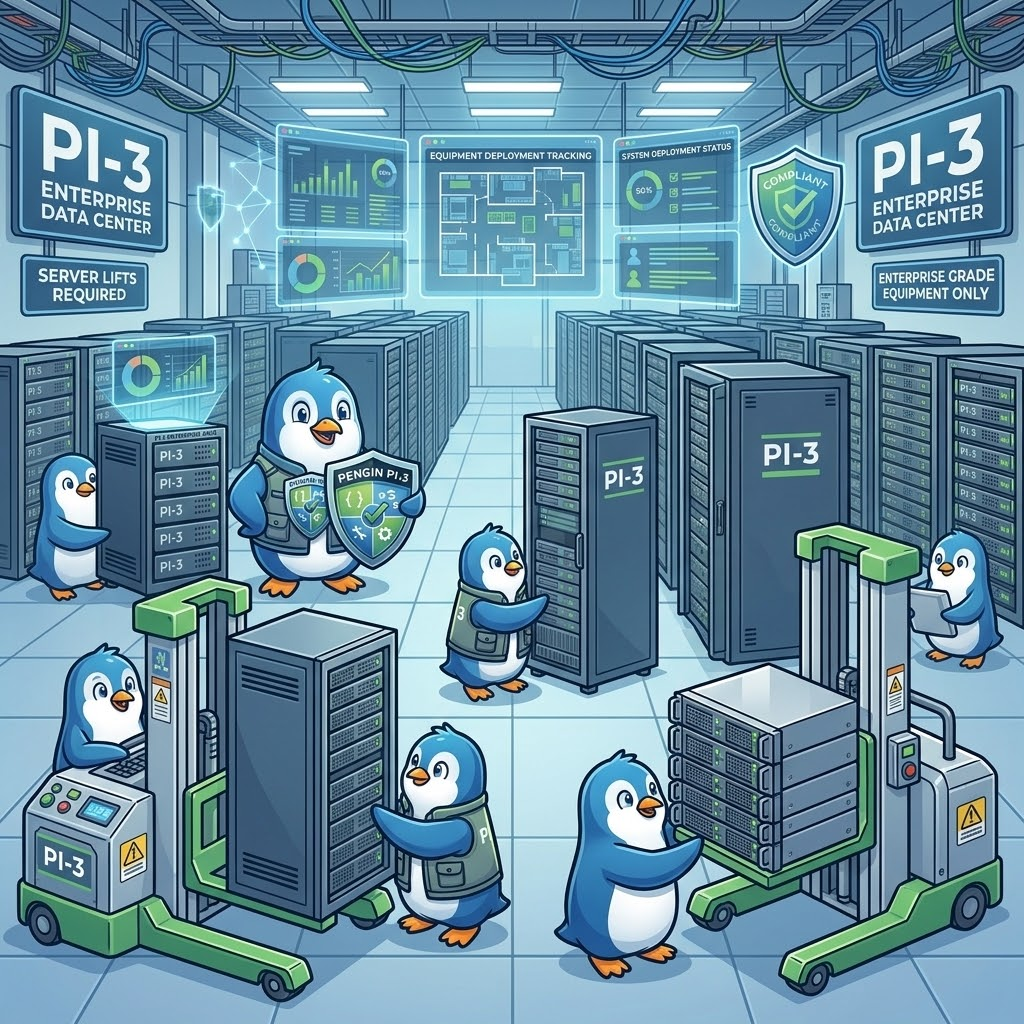
Service Overview
Orchestrating Enterprise Data Center Moves, System Decommissioning, and Asset Lifecycle Management
In an era of hybrid cloud adoption, data center consolidation, and rapid hardware refresh cycles, managing enterprise IT infrastructure across its operational lifespan requires strict governance. Migrating active production workloads, decommissioning end-of-life (EOL) architecture, and maintaining continuous asset visibility present complex operational, security, and compliance challenges.
Unplanned downtime, missing chain-of-custody documentation, or un-sanitized storage media during a physical relocation can lead to severe operational disruptions, regulatory penalties, and reputational damage. Establishing a standardized, highly regulated lifecycle playbook for enterprise equipment moves and system retirements is essential for maintaining enterprise resilience.
1. Enterprise Equipment Relocation Playbook
Moving physical compute, network, and storage infrastructure between enterprise environments—whether across racks, rooms, or geographic locations—requires multi-phased planning, precise dependencies mapping, and secure transport protocol execution.
Phase 1: Pre-Move Audit and Dependency Mapping
- Infrastructure Inventory Verification: Reconcile Configuration Management Database (CMDB) records against physical hardware using visual checks and automated discovery tools.
- Application-to-Infrastructure Mapping: Identify critical workload dependencies across physical servers, hypervisors, network switches, and storage area networks (SAN).
- Risk Assessment & Maintenance Windows: Define operational downtime limits, obtain change advisory board (CAB) sign-offs, and secure maintenance windows.
Phase 2: De-installation and Packaging Protocols
- Graceful System Shutdown: Initiate controlled OS shutdowns, unmount storage volumes, and isolate power feeds.
- Cable Tagging & Topology Recording: Document fiber, ethernet, and power distribution unit (PDU) connectivity layouts using standardized labeling.
- ESD-Safe De-racking: Remove units using anti-static wrist straps, protective padding, and calibrated rail equipment.
- Secure Enclosure: Seal equipment in anti-static bags, shock-absorbent custom foam enclosures, and tamper-evident transit crates.
Phase 3: Secure Transit & Chain of Custody
Maintain unbroken chain-of-custody tracking throughout transit:
- Origin Facility: Tamper-evident seals applied and verified against the master transit log.
- Secure Transport: GPS-tracked, climate-controlled transport with air-ride suspension.
- Destination Facility: Seal inspection, serial number sign-off, and verified rack mounting.
2. Systematic Decommissioning & Data Sanitization
Retiring end-of-life systems demands methodical execution to prevent data leakage and operational degradation. The decommissioning workflow must follow strict security standards.
Data Sanitization Standards
All storage media scheduled for retirement or relocation must undergo sanitization compliant with NIST SP 800-88 Rev. 1 Guidelines for Media Sanitization:
| Sanitization Level | Target Media | Method | Verification Standard | | :--- | :--- | :--- | :--- | | Clear | Non-sensitive SATA/SAS HDDs | Overwrite using logical interface commands. | Automated pattern pass-verification. | | Purge | SSDs, Enterprise NVMe, SAN arrays | Cryptographic Erase (CE) or Block Erase. | Drive-level firmware execution log review. | | Destroy | Failed drives, Top-Secret/Classified storage | Physical degaussing followed by mechanical shredding (≤ 12mm particle size). | Serialized Certificate of Destruction (CoD). |
Critical Compliance Note: Never release physical media from secure custody without a digitally signed, serial-matched Certificate of Destruction or Wiping Verification Log attached to the IT Asset Management (ITAM) record.
3. IT Asset Management (ITAM) & CMDB Lifecycle Tracking
Accurate asset tracking prevents asset leakage, optimizes software licensing costs, and streamlines financial reporting. Systems must transition through clear operational states in the CMDB.
Asset Lifecycle State Progression
- In Service: System active in production environment.
- In Transit: Equipment uninstalled and being moved between locations.
- De-installed: Hardware physically detached and held in secure staging.
- Pending Data Sanitization: Storage drives awaiting NIST 800-88 purging or physical destruction.
- Sanitized / Certified: Drives wiped, certificates attached to asset records.
- Disposed / Recycled: Asset sold via ITAD or sent for certified e-waste recycling.
Essential Database Tags and Metadata
When registering asset lifecycle events within enterprise tracking platforms, maintain uniform, queryable metadata strings:
equipment-relocation, system-decommissioning, asset-retirement, data-center-migration, equipment-move, server-decommissioning, data-sanitization, nist-800-88, physical-asset-management, chain-of-custody, asset-disposition, e-waste-recycling, secure-transit, hardware-decommissioning, lease-return, asset-tagging, infrastructure-relocation, hard-drive-shredding, compliance-hold, licensing-reclaim
4. Financial Reclamation and Sustainable E-Waste Recycling
Decommissioning offers opportunities to reclaim operating capital and achieve environmental compliance:
- Hardware Resale and Value Recovery: Equipment under 4 years old (e.g., enterprise GPUs, high-density RAM modules, network switches) can be refurbished and sold via certified IT Asset Disposition (ITAD) channels.
- Software License Harvesting: Retiring physical nodes allows enterprise teams to reclaim software licenses (e.g., VMware ESXi, Windows Server, Oracle DB), reducing ongoing renewal expenditures.
- Responsible Recycling: Non-marketable hardware must be processed through e-Stewards or R2v3 certified recyclers to prevent hazardous e-waste from entering landfills while reclaiming precious metals.
Summary Checklist for Operations Teams
- [ ] Reconcile CMDB asset entries prior to power-down.
- [ ] Verify data backup integrity before disconnecting infrastructure.
- [ ] Execute NIST 800-88 compliant sanitization and log serial numbers.
- [ ] Inspect tamper-evident packaging and sign transit manifests.
- [ ] Reclaim licenses and update financial lifecycle records post-decommissioning.
© 2026 Enterprise IT Infrastructure & Asset Management Governance Group.